In the last week, Germany and as of this morning Italy, have both comprehensively failed in meeting targets set for their bond auctions.
Germany was unable to sell 39% of it's €6bn 10yr issue (with the ECB not surprisingly picking up the rest). The bonds sold at a 2% annual yield.
http://uk.reuters.com/article/2011/11/23/uk-markets-bonds-bunds-idUKTRE7AM0SL20111123
Italy failed in a different way. Although they managed to find buyers for €10bn worth of 6 month paper, they will compensate investors to the sum of 6.5%. This is double the yield from a month earlier.
http://uk.reuters.com/article/2011/11/25/uk-italy-bonds-auction-idUKTRE7AO0EN20111125
A few passing observations on this situation:
1.) Factors I highlighted in my previous article do indeed spell trouble.
2.) Equity indices are approaching a 10 day losing streak.
3.) Confidence in Germany is now starting to fade.
4.) In this climate, tapping investors for money is like drawing blood from a stone. No wonder yields of 2% didn't attract buyers.
5.) The Eurozone crisis worsens and politicians are still vacant.
The articles I've included above make for some interesting, albeit depressing reading.
Next time I write, I'll try and find a positive element to focus on.
Friday, 25 November 2011
Monday, 21 November 2011
Crisis Hits Core
It appears I am not alone in deriving anxiety from current market conditions but from a qualitative perspective I ask the question; do current equity index levels price in debt market trends? In my view, no.


To elaborate, earlier this year (in August) markets worldwide tanked due to fear of debt contagion and a double dip recession (see older posts). At the start of October, the MSCI World Index hit a trough of 1072 marking a 22.6% drop on a high of 1385 seen in May. This movement correlated with rising panic over systemic threat from debt ridden peripheral Euro zone nations. In my view, recent bond market movements confirm the fears of August's speculators. The spotlight (for the time being) turns from Greece and shines with greater intensity on Spain, Italy and now France. Let's take a look at the spreads:
(Above: French 10yr Government Bond Yield, Source: Bloomberg.com)
(Above: Italian 10yr Government Bond Yield, Source: Bloomberg.com)
(Above: Spanish 10yr Government Bond Yield, Source: Bloomberg.com)
With the exception of the French 10yr notes, Italian and Spanish securities have historically moved broadly in negative correlation to global equity markets. The reason for this is they are increasingly being seen as 'risk on' positions. The fact that French Bond movement is now starting to adopt a similar pattern spells trouble. It undermines integrity in an AAA rated security which by definition should be a safe haven. The previous post outlines troubles France is facing.
So why do these numbers warrant my bearish mid-term view on global equities? Starting with Italy, the key figure markets are watching is 7%; the point of no return. History shows indebted nations have required a bailout when the 7% mark is breached. This was the case for Portugal, Greece and Ireland. As I've discussed earlier, the ECB cannot afford to bailout Italy. Even with the recent decision to leverage the EFSF to €1tn, the fund would still be €0.8tn short. The repercussions of an Italian default are somewhat elusive but this would most likely involve the demise of the Euro and drastic reformation of the EU. For the rest of the world it almost assures another recession. While Spanish yields sit at c6.5% this is of course similar concern to Italy.
Based on this analysis, where do I believe equity markets should be priced at this point in time? To continue on with the examination of my home market, I'll base my answer on the FTSE100. In conjunction with the MSCI index, the FTSE100 also bottomed out at the start of October briefly breaching 4,800. Given the threat is now realised rather than merely feared, I don't believe we are too far off seeing at least 5,000 in the next couple of weeks although a lot will rely on whether ECB action can continue to push down European bond spreads. On a more positive note, market researchers are slightly more positive about the chances of another global recession with many predicting a modest slip back into the red as a likely outcome. As has become customary over the previous year, sentiment (and seemingly with it, the entire world) is likely to change over the next couple of weeks so for the time being, I eagerly watch.
Sunday, 20 November 2011
Market Report - France
Apologies for having not updated the site in a while. I was recently required to construct a market report on France which I thought may be of interest to some of my readers:


Overview
The
French economy was reported to have expanded by an encouraging 0.4 percentage
points in Q3 (QonQ) on Tuesday, having experienced a 0.1 percentage point
contraction on the previous three readings.
This compares to a 0.2 percentage point expansion across the currency
bloc.
In an
effort to balance public favour with an essential requirement for French
austerity, the same Nicolas Sarkozy who marched into a European Finance
minister’s meeting Brussels in 2007 proclaiming ‘France would postpone its
commitment to balancing it’s budget by 2 years’ has recently attempted to
reinvent himself through adopting unspecific plans to raise €65bn through tax
hikes and budget cuts over the next 5 years.
Economists say there is no visible growth strategy in place to counter
these cuts. This move is largely thought
to protect France’s AAA credit rating which Moody’s currently has under review. On November 7 the government
unveiled its second austerity plan in three months. This one promises an extra €7bn in 2012 on
top of the €11bn announced in August at an emergency meeting. Despite these cuts, a report by the Lisbon
council on Tuesday said France’s inability to make rapid adjustments to its
economy should be ringing alarm bells for the Euro zone. It ranked France 13th out of 17
for its overall health, including its growth potential, employment rate and
consumption, and 15th for its progress on economic adjustments,
particularly on reducing its budget deficit and keeping a lid on unit labour
costs.
‘Analyst
sentiment predicts France is likely to slip back into a mild recession by the
end of the year’ a comment from ING Economist Carsten Brzeski states. A senior EU official highlighted the
important contribution France must offer over the next month if the Euro zone
is to be protected: “Between now and
December 9th [date of next European Summit], Germany has to decide
what it is prepared to put on the table to save the euro and others, especially
the French, have to show how far they are willing to go to meet Germany’s
requirements.”
Financial Markets
French
equity markets have been hit particularly hard since the start of August,
primarily due to vast Banking sector exposure to Greek debt ($51.3bn). While the threat of a double dip recession
looms large, the CAC40 has increasingly been leveraged to European systemic
risk. A 50% voluntary write down on
privately held Greek government debt offered French Banks temporary relief to plummeting
share prices. BNP Paribas rose c.20% on
the news but has since retraced to support at €0.30 per share (down from a high
of €0.60 in February). Other French
banks have followed suit reflecting investor concern for Greek debt exposure.

On Tuesday
15th, French sovereign bond yields triggered alarm bells as bearish
sentiment began to weigh in on the concern that European debt contagion (and
the ineffectiveness of European politicians to solve the crisis) was starting
to have an influence on the safety of French debt.

At market close, 10 year French Bond yields
sat at 3.71%, a euro-era high. "It's
a confidence crisis," said Elwin de Groot, a senior market economist at
Rabobank Nederland in Utrecht, Netherlands. "Investors have no confidence
that the euro zone can solve its problems. They will look for the most safe
place they can store their money, which is Germany. Everything else is
suffering."
Friday, 28 October 2011
Market Overview 27/10/11 - 'The Plan'
On Thursday 27th October, markets worldwide rallied strongly on news that a 'comprehensive package' was established, designed to protect the Euro zone from the vast systemic threats currently knocking on the door of the global economy. I for one am delighted with this progress and thrilled to be writing on more positive terms for the first time in a while. Before we get to the charts, let's take a look at the headlines:
Under the second scheme, the EFSF would create a set of special-purpose vehicles financed by other investors, including sovereign-wealth funds. Again, there are reasons to doubt whether this will work. Each vehicle seems to be dedicated to a single country, so risk is not spread. And why should China or Brazil invest a lot in them when Germany is holding back from putting in more money?
Together, these schemes are supposed to extend the value of the EFSF to €1 trillion ($1.4 trillion) or more. Sadly, that looks more like an aspiration than a prediction. And because the EFSF bears the first losses, its capital is at greater risk of being wiped out than under a loan programme." (Full article here)
This was where the news had greatest impact:"


- Banks to take a 'voluntary' (forced) write down of 50% their exposure to Greek debt.
- EFSF to be leveraged to the value of €1tn (NB - Not the €1.8tn needed to support Italy in the event of a default.)
The Economist Newspaper offers further detail (albeit rather critical) on the leverage of the EFSF:
"Unfortunately the euro zone’s firewall is the weakest part of the deal (see article). Europe’s main rescue fund, the European Financial Stability Facility (EFSF), does not have enough money to withstand a run on Italy and Spain. Germany and the European Central Bank (ECB) have ruled out the only source of unlimited support: the central bank itself. The euro zone’s northern creditor governments have refused to put more of their own money into the pot.
Instead they have come up with two schemes to stretch the EFSF. One is to use it to insure the first losses if any new bonds are written down. In theory, this means that the rescue fund’s power could be magnified several times. But in practice, such “credit enhancement” may not yield much. Bond markets may be suspicious of guarantees made by countries that would themselves be vulnerable if their over-indebted neighbours suffered turmoil.
Instead they have come up with two schemes to stretch the EFSF. One is to use it to insure the first losses if any new bonds are written down. In theory, this means that the rescue fund’s power could be magnified several times. But in practice, such “credit enhancement” may not yield much. Bond markets may be suspicious of guarantees made by countries that would themselves be vulnerable if their over-indebted neighbours suffered turmoil.
Under the second scheme, the EFSF would create a set of special-purpose vehicles financed by other investors, including sovereign-wealth funds. Again, there are reasons to doubt whether this will work. Each vehicle seems to be dedicated to a single country, so risk is not spread. And why should China or Brazil invest a lot in them when Germany is holding back from putting in more money?
Together, these schemes are supposed to extend the value of the EFSF to €1 trillion ($1.4 trillion) or more. Sadly, that looks more like an aspiration than a prediction. And because the EFSF bears the first losses, its capital is at greater risk of being wiped out than under a loan programme." (Full article here)
This was where the news had greatest impact:"
Above: Equity Indices in Europe open strongly and continue to gain momentum over the next 24 hours.
The Euro breaks through 1.4 against the dollar and support forms just under 1.42.
Banks with exposure to Greek debt encounter huge gains. Soc Gen up c20% yesterday.
 Risk on currencies such as the CAD and AUD strengthened as investors exited 'safe havens.'
Monday, 24 October 2011
Outcome of European Summit (pt.2/?)
So, 8 days have passed and once again our European 'leaders' convene. As I predicted last week, today's summit returned little progress towards finding a solution to the many problems now facing the Euro zone (and as a result, the global economy). To emphasise on the all too familiar 'kicking the can down the road' demeanour governors appear to be adopting, it has been announced that final decisions will now be deferred until a second summit on Wednesday 26th (stay tuned for pt.3)
Given nothing was achieved this weekend, lets take a snapshot glance at what was discussed:
Given nothing was achieved this weekend, lets take a snapshot glance at what was discussed:
- Sarkozy backed down to German opposition to use unlimited European Central Bank funds to fight the crisis. (As a result, the Euro zone may turn to emerging economies for bond market support.)
- It probably wouldn't hurt at this stage to examine an updated perspective of the developing relationship between Germany and France. Last week the world observed progression as signs of collaboration emerged. This week, we witness the French bullied out of their ideas.
- Italy comes under pressure to produce a more 'convincing' plan to implement structural reforms within its domestic economy. Berlusconi to call a cabinet meeting on Monday morning to discuss measures to boost growth.
- (Excuse my petulant interruption but is this to say that every option to stimulate growth in Italy hasn't already been reviewed by this stage!?)
- Merkel said only two options remained on the table for leveraging the €440 EFSF and neither involved drawing on the ECB.
- Officials said the emerging solution would combine using the EFSF to provide partial guarantees to buyers of new Italian and Spanish bonds, while also creating a special purpose vehicle (read the at_best analysis on the Special Purpose Vehicle here) to attract funds from major emerging countries that could guarantee bonds in the secondary market (Source: Reuters.)
- Broad framework drafted for recapitalising European banks - €100-110bn support, €46bn of which was already put aside for bank support in the EU/IMF bailout programs for Ireland, Greece and Portual - the market wanted a figure of around €200bn, instead they got c.€60bn.
- Discrepancy continues as to the value banks must accept on Greek debt write downs. Banks are citied to have offered 40%, governments are apparently demanding 60%, market consensus is 50%.
Sunday, 23 October 2011
Who Owes What?
Continuing on with the contagion theme, this illustration offers a visual plan of the crisis and those participants who stand to lose out if action isn't taken soon.
 |
| Mapping the European debt crisis - to enlarge, Click Here (Source: zerohedge.com) |
I believe this supports my view that placing short term pressure on France and Germany is undoubtedly progression, but any conjured solution will fail to address the long term problem.
Monday, 17 October 2011
Reuters Bank Stress Test Simulator
A highly recommended model which allows the user to witness the amount of support needed for domestic banking sectors under varying circumstances.
http://graphics.thomsonreuters.com/11/07/BV_STRSTST0711_VF.html
http://graphics.thomsonreuters.com/11/07/BV_STRSTST0711_VF.html
Sunday, 16 October 2011
G20 Meeting & European Response
"You have 8 days" G20 Finance Ministers asserted to their European counterparts this weekend, as a lack of agreement on key issues continued and will likely be the talking point of the market on Monday morning. Below is a summery of key outcomes and targets:
- Pressure mounted on Europe to derive a solution to its snowballing debt crisis to be presented at a continental summit in just 8 days.
- IMF offer the prospect of wider international support if European lenders deliver on the promises and commit more of their own financial backing.
- Details to be finalised on a comprehensive plan to recapitalise European banks.
- Europe is to come up with a feasible solution to the Greek debt crisis (haha)
- Details of whether the current EFSF safety net is to be leveraged/increased and to what amount.
- Decision on exact haircut banks will incur on Greek debt (current contribution is 21% as agreed in July).
At a glance, it is immediately obvious Europe have a lot of work to do. I for one highly doubt the outcome to the European Summit to be held next weekend will satisfy the requests of anybody, let alone the market or G20. While it's encouraging to witness global pressure finally impose a deadline (or would ultimatum be more appropriate?) there is too much ground to cover in too short of a period of time. The underlying problem with this current situation is each Euro zone governments responds to bodies of people with different requirements, so reaching an agreement in such a short period of time is unrealistic. In my view, we will witness a very similar situation to the squabbling which dominated congress around the end of July when the US debt ceiling was under review. Plans to develop higher levels of fiscal integration within Europe could be what the market is looking for here, but for the same reasons as I mentioned earlier, I believe the chances of this happening are next to none.
Wednesday, 12 October 2011
QE2 - The Vessel Designed to Stimulate our Economy
Last Thursday, the Bank of England announced its intention to launch a second round of a highly anticipated project known as quantitative easing (coined QE2 for short). The market reacted positively to the headline statement; an additional £75bn will be printed, marking a 50% increase on the £50bn consensus. Before exploring the implications of this news, let us first examine what QE is and why the BoE deem it necessary at this point in time.
Put simply, QE is an unconventional form of monetary policy, where a central bank prints its own currency and buys assets. In this case, the capital will be used to purchase UK Government Gilts (evenly weighted across all maturities). The policy has two core objectives:
- Lower the yield on UK Government debt (making borrowing on the money market more affordable.)
- Creating a trickle down effect starting with banks and other financial institutions who vend the assets providing them with more liquidity (and therefore credit) to offer to businesses looking to borrow.
Essentially, the plan is designed to 'loosen' the pockets of UK businesses, encouraging them to spend their way back to growth.
The extent to which printing will occur is certainly an issue to be scrupulous of. In my view, the additional £25bn on market consensus is an elusive reflection of the systemic threat to our economy from Europe (and indeed the rest of the globe). As discussed in a previous article, Greece has already put tremendous pressure on credit lines and this reaction confirms liquidity in the future could be a serious issue. Others have also questioned the extent to which inflation (CPI currently at 4.5%) could be a direct outcome of this policy. Simple supply/demand economics state that if supply increases (in this case, supply of currency), demand will fall (the value of the pound.) While BoE policy maker Martin Weale insists "evidence shows that QE does support the economy and there is no reason to believe that it feeds directly into inflation without supporting growth," I remain sceptical of his latter point. The BoE currently anticipate inflation rising above 5% in the short term but dropping heavily below the 2% target in the medium term (primarily next year.)
So what will be the benefits of this announcement? First, lets take a glance at the immediate impact. Directly comparing the FTSE against the Dow Jones (the latter re-based on the morning additional QE was announced) we witness the FTSE making progress:
Although progress on this relatively simplistic chart could be attributable to any factor within the UK, it is fair to say the majority may be attributed to the QE programme. Looking out to the medium term, not surprisingly, the lasting impact is much harder to predict. QE1 supported the domestic economy through one of the most potent rises in recent history, the benefits ultimately lasting a year and a half. The subject of diminishing returns comes into play however and I believe this wave of QE will only be enough for the next 6 months, after which the effect will ease off and essentially we'll be back to reality.
Except many believe we won't. Michael Saunders of Citi shares a view fairly indicative of the general consensus on this matter:
"I think it's the right thing to do, I think they will do lots more QE. What is important is they are moving ahead of consensus and that is likely to have a fairly powerful downward effect on yields, which is what they want to achieve. And they will go on doing QE until prospects for the economy improve significantly, or until they own the whole gilt market."
"He said his 'best guess' was the Bank of England would do 300 billion pounds of QE on top of the 200 billion done so far, bringing the cumulative amount to 500 billion. "Today's 75 is part of that 300. But that's only a rough guess and the key point is it is going to come in large scale."
"It's both that the economy is weak but also that the MPC's view is that QE is not a very powerful tool, or rather it takes a large amount of QE to have much effect on the economy. I think that in the markets people don't appreciate that what comes from that is that the MPC will use QE in a very large scale because it is only in very large scale that QE has a notable effect." (uk.reuters.com)
While I agree this is certainly the right action to be taking at this point in time, my view remains bearish on short term market support at this level. I believe it is only a matter of time before the systemic threat of Europe starts to dominate market sentiment once again and the market needs more than just a 'promise of a promise' from MerKozy before the FTSE solidifies itself above the 5,400 level.
"He said his 'best guess' was the Bank of England would do 300 billion pounds of QE on top of the 200 billion done so far, bringing the cumulative amount to 500 billion. "Today's 75 is part of that 300. But that's only a rough guess and the key point is it is going to come in large scale."
"It's both that the economy is weak but also that the MPC's view is that QE is not a very powerful tool, or rather it takes a large amount of QE to have much effect on the economy. I think that in the markets people don't appreciate that what comes from that is that the MPC will use QE in a very large scale because it is only in very large scale that QE has a notable effect." (uk.reuters.com)
While I agree this is certainly the right action to be taking at this point in time, my view remains bearish on short term market support at this level. I believe it is only a matter of time before the systemic threat of Europe starts to dominate market sentiment once again and the market needs more than just a 'promise of a promise' from MerKozy before the FTSE solidifies itself above the 5,400 level.
Friday, 30 September 2011
Alessio Rastani - BBC Trader Interview
Admittedly, I've jumped on the bandwagon a little late with this one, but the ratification this trader employs with his 3 minute rant is quite staggering and potentially exposes an ugly side of an industry with many secrets.
Despite the fact Mr. Rastani may touch on some critical points, I refute the statement 'the stock market, and with it the euro are finished.' The very definition of efficient markets undermines his point, at least for the time being and suggests there is still a great deal of hope out there.
Despite the fact Mr. Rastani may touch on some critical points, I refute the statement 'the stock market, and with it the euro are finished.' The very definition of efficient markets undermines his point, at least for the time being and suggests there is still a great deal of hope out there.
Tobin Tax - To Bin our Financial Services Sector
On September 28th, The European Commission formally proposed a Financial Transactions Tax (coined 'Tobin Tax' after the Economist James Tobin). Having accomplished so much in his academic life, I find it somewhat disappointing that his legacy will live on in the form of a levy which may very well strangle the growth and stability he sought to promote.
Moving on from the tax's pseudonym, the paradigm of the EC's proposals would be to impose a toll of 0.1% on every security transaction involving EU based financial institutions. All OTC derivative deals would also incur a tax of 0.01% on the principal amount of the transaction. The objective; to raise an indicative €55 billion for European Union nations. The implications on the other hand will be far less black and white.
Turning attention first to those who are in favour of implementing such proposals, we witness three key arguments. The first is obvious (and appears in my view to be the only one the EC have considered), the tax will raise money for a debt ridden area in times of austerity and economic hardship. The second, is more personal. People want banks and financial institutions to foot the bill for a problem they created (which is understandable and in a just world may be a little more persuasive). Finally, supporters realise this could be the end of high-frequency traders and with it, the bad money that follows. HFTs aim (in the most part) to capitalise off of arbitrage; trading many times a second, taking advantage of pricing indifferences. As a result, computers account for c.90% of market transactions and have therefore 'taken over' in a terminator style saga (to put it melodramatically).
The problem is though, supporters will likely receive a fraction of the returns expected from the intrinsic benefit of the toll. Financial institutions' whose cages have already been rattled by Basel III and (within the micro arena), proposals such as the Vickers report (see earlier post), will likely use this as an opportunity to move to other parts of the world where they can retain their competitive edge. HSBC have already threatened to move to Hong Kong and ICAP, a FTSE100 inter-dealer broker have threatened they may move off-shore if the Tobin tax were to be instated.
The EC claim (at this stage) to implement the toll only if political agreement throughout the EU is unanimous. Speculators believe however that they may go ahead regardless, which could have a positive impact on the UK market share of the global financial services industry if Britain were to veto the proposal. Given Britain's status as one of the world's dominant financial centres, I don't see the Coalition Government signing up (thankfully.)
On a final note, I dare say I'm in agreement with a Tobin tax, if acceptance was world-wide. I very much doubt this is possible however, considering each nation has their own incentives to promote business.
Moving on from the tax's pseudonym, the paradigm of the EC's proposals would be to impose a toll of 0.1% on every security transaction involving EU based financial institutions. All OTC derivative deals would also incur a tax of 0.01% on the principal amount of the transaction. The objective; to raise an indicative €55 billion for European Union nations. The implications on the other hand will be far less black and white.
Turning attention first to those who are in favour of implementing such proposals, we witness three key arguments. The first is obvious (and appears in my view to be the only one the EC have considered), the tax will raise money for a debt ridden area in times of austerity and economic hardship. The second, is more personal. People want banks and financial institutions to foot the bill for a problem they created (which is understandable and in a just world may be a little more persuasive). Finally, supporters realise this could be the end of high-frequency traders and with it, the bad money that follows. HFTs aim (in the most part) to capitalise off of arbitrage; trading many times a second, taking advantage of pricing indifferences. As a result, computers account for c.90% of market transactions and have therefore 'taken over' in a terminator style saga (to put it melodramatically).
The problem is though, supporters will likely receive a fraction of the returns expected from the intrinsic benefit of the toll. Financial institutions' whose cages have already been rattled by Basel III and (within the micro arena), proposals such as the Vickers report (see earlier post), will likely use this as an opportunity to move to other parts of the world where they can retain their competitive edge. HSBC have already threatened to move to Hong Kong and ICAP, a FTSE100 inter-dealer broker have threatened they may move off-shore if the Tobin tax were to be instated.
The EC claim (at this stage) to implement the toll only if political agreement throughout the EU is unanimous. Speculators believe however that they may go ahead regardless, which could have a positive impact on the UK market share of the global financial services industry if Britain were to veto the proposal. Given Britain's status as one of the world's dominant financial centres, I don't see the Coalition Government signing up (thankfully.)
On a final note, I dare say I'm in agreement with a Tobin tax, if acceptance was world-wide. I very much doubt this is possible however, considering each nation has their own incentives to promote business.
Tuesday, 27 September 2011
European Investment Bank's 'Special Purpose Vehicle'
Although I take no credit for this post, the underlying synopsis of this article by zerohedge.com provides some indication as to why equity markets have rebounded so decisively off of support over the past 48 hours:
(To trim the article around the edges, below is the underlying paradigm. For those who'd like to read the full (brilliant) analysis, I've included the link):
"Nothing has been officially announced, but according to a news article
published by CNBC here is what this new structure could look like (there are
lots of moving parts):
- It would involve money from the European Financial Stability Facility (EFSF), a bailout vehicle created in 2010 to alleviate the sovereign debt crisis in Europe, to capitalize a special purpose vehicle that would be created by the EIB, a bank owned by the member states of the European Union.
- The special purpose vehicle would issue bonds to investors and use the proceeds to purchase sovereign debt of distressed European states.
- This could potentially alleviate the pressure on the distressed states and on the European banks that hold a lot of the distressed sovereign debt. The bonds issued by the special purpose vehicle could then be used as collateral for borrowing from the European Central Bank (ECB), allowing the central bank to make loans to banks faced with liquidity shortages.
- They would buy bonds of the special purpose vehicle, and those bonds could be used to access liquidity facilities from the ECB.
As far as equity markets (and no doubt European banks) are concerned, implementation of such a strategy would take a mountain of pressure off of balance sheets and although somewhat far fetched, could be a feasible short term solution to the volatility we're currently seeing.
I agree with the author of this post (Tyler Durden reconstructing the views of David Rosenberg), this is most likely another deterrent from the real problem. I further believe implementation, if (legislatively possible) will be a timely process and thus the superfluous strength this 'rumour' has spurred will most likely be sold into at the 5,400 level on the FTSE100. I also remain pessimistic on Merkel's ability to retain any form of control over her unruly parliament and thus I envisage it will be some time until the EFSF's fund holds the necessary fire power to sooth markets. Volatility until Christmas, here we come.
Wednesday, 21 September 2011
The Implications of a Greek Default - How Will Markets React?
Despite speculation that yesterday would mark a catastrophic Greek default, news yesterday morning indicated the insolvent nation did in fact come up with the €769 million required in coupon payments on 2040 and 2037 bonds. The questions therefore remain; will Greece default and if so when. To address the first, we take note of the fact Credit Default Swap spread for Greek sovereign debt prices in a near 100% chance of default. Assuming therefore this event is more than likely to happen, the only question remaining is when. Personally, I subscribe to the view that it will happen early 2012 regardless of actions taken by the rest of Europe to prevent it. In terms of other debt-ridden European nations, this illustration by CNN provides some indication of the likelihood of the default of other nations (indicative again of CDS spreads).
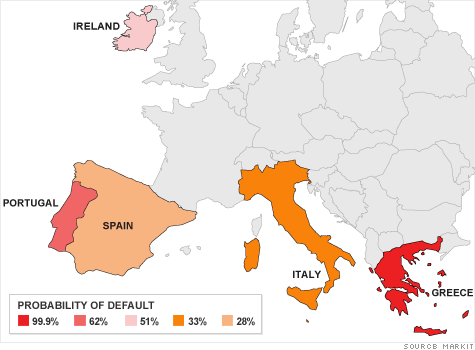
This article aims to address therefore the likely outcome of a Greek default on financial markets. Without the resources at my disposal to look at micro effects, I shall offer my opinion only on macro repercussions.
Looking first at the bond market, the most obvious consequence would be elevated pressure on the nations highlighted above. It's logical to assume bond yields on sovereign debt would rise as a Greek default would likely set a precedent that other indebted nations could follow. This is the nature of Eurozone contagion. The key 'security' (to use the term loosely) in this scenario would be the yield activity on Italian and Spanish 10-year debt. History tell us the tipping point has been 7%, after which borrowing on money market ceases to be economically viable. It would also prove exceptionally difficult to bring the yield back down below this level and hence the downward spiral Greece found itself in all too recently could begin. In terms of AAA rated sovereign debt, I'd imagine these yields to lower as a 'risk off' mode comes into play and investors flock to safe haven assets.
The next major blow would likely be struck upon the banking industry, mainly in Europe but also throughout the world. The link below graphically illustrates relative exposure each nation's banks have to other European nations:
http://www.ft.com/cms/s/0/9686c004-fca4-11df-bfdd-00144feab49a.html#axzz1YavOr400
At a glance it would appear French banks (whose stock prices are currently being dealt hell) would fare the worst from a Greek default. French exposure to Greek debt currently stands at $52.9bn, followed by Germany; $35.7bn and then the United Kingdom, $13.7bn. French and German banks are also the greatest owners of Italian debt, holding $404.9bn and $164.9bn respectively. We can therefore assume both France and Germany would be the hardest hit by a Greek default (which in my view, surely steps up the argument for their parent governments to adopt some sort of Eurobond asap.) Perhaps a more significant outcome, rather than just monetary loss from this situation is the second credit crunch that could follow. A quote from Gary Jenkins, head of fixed income research at Evolution Securities states "you would get the loss on the Greek debt of course, but I think much more important is the funding situation. Who is going to be lending the banks money if you have got Euro Zone sovereigns defaulting and you are unsure about what is going to happen next?" (Source: Reuters)
In accordance with the Capital Allocation Pricing Model, equity markets would also take a drastic hit as bank shares tank, dragging everything else lower. The ability of banks to lend would also be pulled into question and funding for future operations could come to a standstill. By all accounts, this would be more than likely to result in a double dip recession.
Looking on the bright side, some of the biggest gains in stock market history were recorded last year and when the dust finally does settle, there will be many companies out there with no where to go but up. More importantly though it could give countries, banks, the Euro and people the chance at a fresh, debt free start. At present, I for one fail to see the end to the current crisis. Perhaps in time this will come to be known as the perfect solution to an imperfect problem.
This article aims to address therefore the likely outcome of a Greek default on financial markets. Without the resources at my disposal to look at micro effects, I shall offer my opinion only on macro repercussions.
Looking first at the bond market, the most obvious consequence would be elevated pressure on the nations highlighted above. It's logical to assume bond yields on sovereign debt would rise as a Greek default would likely set a precedent that other indebted nations could follow. This is the nature of Eurozone contagion. The key 'security' (to use the term loosely) in this scenario would be the yield activity on Italian and Spanish 10-year debt. History tell us the tipping point has been 7%, after which borrowing on money market ceases to be economically viable. It would also prove exceptionally difficult to bring the yield back down below this level and hence the downward spiral Greece found itself in all too recently could begin. In terms of AAA rated sovereign debt, I'd imagine these yields to lower as a 'risk off' mode comes into play and investors flock to safe haven assets.
The next major blow would likely be struck upon the banking industry, mainly in Europe but also throughout the world. The link below graphically illustrates relative exposure each nation's banks have to other European nations:
http://www.ft.com/cms/s/0/9686c004-fca4-11df-bfdd-00144feab49a.html#axzz1YavOr400
At a glance it would appear French banks (whose stock prices are currently being dealt hell) would fare the worst from a Greek default. French exposure to Greek debt currently stands at $52.9bn, followed by Germany; $35.7bn and then the United Kingdom, $13.7bn. French and German banks are also the greatest owners of Italian debt, holding $404.9bn and $164.9bn respectively. We can therefore assume both France and Germany would be the hardest hit by a Greek default (which in my view, surely steps up the argument for their parent governments to adopt some sort of Eurobond asap.) Perhaps a more significant outcome, rather than just monetary loss from this situation is the second credit crunch that could follow. A quote from Gary Jenkins, head of fixed income research at Evolution Securities states "you would get the loss on the Greek debt of course, but I think much more important is the funding situation. Who is going to be lending the banks money if you have got Euro Zone sovereigns defaulting and you are unsure about what is going to happen next?" (Source: Reuters)
In accordance with the Capital Allocation Pricing Model, equity markets would also take a drastic hit as bank shares tank, dragging everything else lower. The ability of banks to lend would also be pulled into question and funding for future operations could come to a standstill. By all accounts, this would be more than likely to result in a double dip recession.
Looking on the bright side, some of the biggest gains in stock market history were recorded last year and when the dust finally does settle, there will be many companies out there with no where to go but up. More importantly though it could give countries, banks, the Euro and people the chance at a fresh, debt free start. At present, I for one fail to see the end to the current crisis. Perhaps in time this will come to be known as the perfect solution to an imperfect problem.
Thursday, 15 September 2011
Market Reaction to a Hint of Political Direction
In a previous post I offered my view on market pressure influencing the actions of subordinate politicians. It would appear, however, that during the course of this week, leaders have stepped up their game (ever so slightly) and may even be regaining control of the situation. Germany and France have reiterated their support for Greece and talk of the Euro Bond is becoming ever more potent. Don't get me wrong, this positive progress could be reversed in a second but for the time being the markets are seeing a modest recovery. With regards to authoritarian sentiment weighing towards Euro Bond implementation, this article by Reuters is extremely useful.
http://uk.reuters.com/article/2011/09/15/uk-eurozone-eurobonds-idUKTRE78E1CE20110915
In this post, I'd like to take the chance to reiterate the importance I place behind a top-down approach to tackling this crisis. Let's take a look at what has sparked positive movements in the FTSE100 this week:

On Tuesday, fresh concern arose around an imminent Greek default (an economy which is due to run out of cash in October if the latest tranche (8bn euros) of the EFSF bailout package isn't forthcoming. As per usual, the market tanked as investors faced the uncertainty of the resulting impact of the inevitable (the yield of 146% on Greece's 1 yr bond says it all). Since however, it has rallied mainly due to two signs of political strength (or should I say hope?):
http://uk.reuters.com/article/2011/09/15/uk-eurozone-eurobonds-idUKTRE78E1CE20110915
In this post, I'd like to take the chance to reiterate the importance I place behind a top-down approach to tackling this crisis. Let's take a look at what has sparked positive movements in the FTSE100 this week:
On Tuesday, fresh concern arose around an imminent Greek default (an economy which is due to run out of cash in October if the latest tranche (8bn euros) of the EFSF bailout package isn't forthcoming. As per usual, the market tanked as investors faced the uncertainty of the resulting impact of the inevitable (the yield of 146% on Greece's 1 yr bond says it all). Since however, it has rallied mainly due to two signs of political strength (or should I say hope?):
- Merkel & Sarkozy reassured markets they simply wouldn't let Greece tumble out of the Euro Zone.
- Whispers of a Euro Bond arose around the corridors of parliaments around Europe.
Although seemingly insignificant 'actions,' this is raw demonstration of the importance of political leadership in today's market. Negative news continues to tumble in (UBS's $2bn hit, World Bank chief stresses the danger the economy faces etc.) but political union has trumped to deliver a rise.
Merkel now needs to swallow her pride, stop hiding behind her prized AAA gov. bond and take control of the situation. Unfortunately, as I write, this just in;
Tuesday, 13 September 2011
Sir John Vickers Report - An Analysis on Ring Fencing the UK
Yesterday marked the release of the anxiously awaited Sir John Vickers' government backed Independent Commission on Banking report. The headline statement called to implement regulations across Britian's major banks referred to as 'ring fencing,' a paradigm which would separate Investment Banking division from Retail Banking. In theory, this division would remove the need for tax payers to foot the bill for British banks in the event of another credit crunch in the future, while in practice the outcome may be fickle at best. Before examining this in detail, I first think's important to examine two representations from well informed sources which caught my eye.
For privacy reasons, I shall omit the name of the first speculator and refer to him as a top analyst employed at Investec in London who follows the financial sector. When I asked his view on ring fencing, his response followed; "ring fencing is a solution in search of a problem. Ring fencing wouldn't have prevented the fall of Northern Rock, Lehman brothers or exempted the need for the government to bailout RBS or HBOS." He developed to state "what happened in 2008 was natural selection; those who were weak got taken out and now, 3 years down the line, we're going to over regulate those who were strong enough to survive in a period of futile recovery." I must say, at the time I shared his view. The ICB would call to close the door after the horse had bolted.
A paragraph in the 'Comment' section of Tuesday's Evening Standard offered up an opposing view from another city insider (again, anonymous): "A glance at the banks' record over the past 30 years shows how parasitic the current arrangements are. He says that over that time frame bank shareholders have lost much of their money, retail savers have done very badly, taxpayers have thrown in billions to keep the banks afloat, and the people who work in financial services have made a bomb." Another hard hitting statement.
Having watched the Q&A session with Vickers yesterday morning it occurred to me despite the disastrous impact this will have on Britain's banks, this is the right action. The ICB is not calling so much for banks to implement ring fencing, it is calling for the government to ring fence the banks from the tax payer.
Having said this, the report painted a disastrously bleak tone for the future of UK banks and indeed therefore the future of the UK's economy. First lets take a look at the indicative headline figures:
Therefore, I take a negative outlook in terms of the future of this country. Although in this instance I believe the benefit of this regulation marginally outweighs the cost, I do not see where growth will come from in the near future. Our service sector is suggested to account for 77% of our economy and by imposing tighter regulations we render ourselves less competitive with other more cavalier nations throughout the world. I do not think the banks will relocate their London HQs but I do think the government needs to keep a close watch on the resultant outcome and review regularly whether the benefits to the people of Britain are being outweighed by the possible slump in our future performance as a nation.
For privacy reasons, I shall omit the name of the first speculator and refer to him as a top analyst employed at Investec in London who follows the financial sector. When I asked his view on ring fencing, his response followed; "ring fencing is a solution in search of a problem. Ring fencing wouldn't have prevented the fall of Northern Rock, Lehman brothers or exempted the need for the government to bailout RBS or HBOS." He developed to state "what happened in 2008 was natural selection; those who were weak got taken out and now, 3 years down the line, we're going to over regulate those who were strong enough to survive in a period of futile recovery." I must say, at the time I shared his view. The ICB would call to close the door after the horse had bolted.
A paragraph in the 'Comment' section of Tuesday's Evening Standard offered up an opposing view from another city insider (again, anonymous): "A glance at the banks' record over the past 30 years shows how parasitic the current arrangements are. He says that over that time frame bank shareholders have lost much of their money, retail savers have done very badly, taxpayers have thrown in billions to keep the banks afloat, and the people who work in financial services have made a bomb." Another hard hitting statement.
Having watched the Q&A session with Vickers yesterday morning it occurred to me despite the disastrous impact this will have on Britain's banks, this is the right action. The ICB is not calling so much for banks to implement ring fencing, it is calling for the government to ring fence the banks from the tax payer.
Having said this, the report painted a disastrously bleak tone for the future of UK banks and indeed therefore the future of the UK's economy. First lets take a look at the indicative headline figures:
- Cost per year: £4-7bn - to be absorbed by banks' shareholders, employees and balance sheets
- Equity capital increase to 10% of assets (Basel III: 7%)
- Banks should have loss absorbing capital of between 17%-20%
- Due date: 2019
Therefore, I take a negative outlook in terms of the future of this country. Although in this instance I believe the benefit of this regulation marginally outweighs the cost, I do not see where growth will come from in the near future. Our service sector is suggested to account for 77% of our economy and by imposing tighter regulations we render ourselves less competitive with other more cavalier nations throughout the world. I do not think the banks will relocate their London HQs but I do think the government needs to keep a close watch on the resultant outcome and review regularly whether the benefits to the people of Britain are being outweighed by the possible slump in our future performance as a nation.
Friday, 9 September 2011
Euro Bonds - The Get Out of Bail Free Card
The phrase 'contagion' or 'contamination,' has driven market sentiment over the course of the year, with those in the driving seat keeping a very close eye on what some speculators believe has already occurred. The theory logically states, when crisis breaks out in one country's bond or equity markets, the trouble is likely to spread to others. Such is the nature of global economic integration in the 21st Century, markets are no longer solely exposed to their own domestic economies but also others around the world. Of course, when a string of debt-ridden countries share a unanimous currency, the threat becomes considerably leveraged.
Apprehension starts with Greece, Ireland and Portugal, three nations which have required monetary assistance from the ECB over the past 2 years. At this stage the banks come into the picture and could arguably be described as the core vehicle through which the 'disease' spreads. This is due to unfavourable positions taken in sovereign debt across euro zone nations, thus, when countries start to struggle with their payments, its the banks who lose out.
Apprehension starts with Greece, Ireland and Portugal, three nations which have required monetary assistance from the ECB over the past 2 years. At this stage the banks come into the picture and could arguably be described as the core vehicle through which the 'disease' spreads. This is due to unfavourable positions taken in sovereign debt across euro zone nations, thus, when countries start to struggle with their payments, its the banks who lose out.
I jump now, to today. I believe August priced in a great deal of what is no longer contagion threat, rather reality. The debt crisis has quickly spread, as feared, from the source to Italy and Spain (the Eurozone's third and fourth largest economies respectively). While it was possible to calm markets with the promise of throwing more money at peripheral EU countries in order to 'solve the problem,' the same cannot be said for Italy and Spain. Therefore, we're faced with a situation where the clock is ticking - the debt crisis across Europe worsens by the hour and the up-until now solution to this problem, lacks fire power against a debt mountain.
Like other speculators, I believe the Euro Bond is the only effective solution. A Euro Bond would serve as a 'joint and several liability bond,' effectively resulting in financially more robust nations (such as Germany and France), vouching for their penny-less counter-parts; Greece and the other trouble makers.
Sarkozy remains typically impartial, so the resistance lies with Merkel. It's obvious as to why this is; Germany, the Euro Zone power house, would have to sacrifice her prized AAA rated sovereign debt, which at present yields c.1.9% on 10yr bunds. This maybe understandable, but it seems to me that the Germans are forking out anyway in this scenario. Either they are forced into offering direct, monetary aid to peripheral nations or their cost of borrowing grows. Unfortunately, I'm not in a position to comment on which one would likely cost the country more. S&P have indicated a Euro Bond would take the rating of the lowest participant, which wouldn't bode too well for the likely yield, but I still believe this is likely to be less than the estimated €2tn required to bail out Italy.
Looking further beyond merely Germany and France, a decision to implement such a security would also do wonders for global financial sentiment and give struggling nations such as Greece (who must currently offer c.20% on their 10 year yield - a figure impossible to finance) an outside chance at sustainable recovery.
Like other speculators, I believe the Euro Bond is the only effective solution. A Euro Bond would serve as a 'joint and several liability bond,' effectively resulting in financially more robust nations (such as Germany and France), vouching for their penny-less counter-parts; Greece and the other trouble makers.
Sarkozy remains typically impartial, so the resistance lies with Merkel. It's obvious as to why this is; Germany, the Euro Zone power house, would have to sacrifice her prized AAA rated sovereign debt, which at present yields c.1.9% on 10yr bunds. This maybe understandable, but it seems to me that the Germans are forking out anyway in this scenario. Either they are forced into offering direct, monetary aid to peripheral nations or their cost of borrowing grows. Unfortunately, I'm not in a position to comment on which one would likely cost the country more. S&P have indicated a Euro Bond would take the rating of the lowest participant, which wouldn't bode too well for the likely yield, but I still believe this is likely to be less than the estimated €2tn required to bail out Italy.
Looking further beyond merely Germany and France, a decision to implement such a security would also do wonders for global financial sentiment and give struggling nations such as Greece (who must currently offer c.20% on their 10 year yield - a figure impossible to finance) an outside chance at sustainable recovery.
In my view, this will have to happen to advert catastrophe. European politicians must be aware of this, and the risks associated with non-action.
Wednesday, 7 September 2011
Heads of State - Crisis Calls for Action
For my maiden post, I'd like to cover what is most likely a fairly basic view on a widely discussed topic.
I believe at this moment in time, financial markets are firmly dictating the next move for politicians worldwide which quite frankly is a disgrace. There's rarely a good word to be said about either Dominique Strauss-Kahn (in my view, he's guilty as sin) or Gordon Brown, but in 2008 their coordinated efforts at least placed politicians in control of the fear and greed of the rich and resultant welfare of everyone else while the markets came crashing down.
To develop on this view, let's take a look at the key figures of power. Obama & Cameron appear to be taking a back seat on this issue producing little, but competent input where necessary. Obama for example with his $300bn job stimulation package as of today and Cameron steering a thankful Britain away from a costly, and most likely nugatory Greek bailout. In my opinion, they are probably taking the right approach.
Let's jump to another key link; Sarkozy & Merkel. In my view, this is where the problem lies. Two heads of state, left in charge of an unfavourable situation. Merkel's rebellion within her own lower parliament is quickly shunning her ability to act on a growing Euro zone debt crisis and drowning the market in negative sentiment, whilst Sarkozy is yet to do, well, anything. Their frequent encounters are indicative of this entire, political predicament. They meet for 'emergency talks' and nothing comes of it.
I will discuss Euro bonds and my views on what should be done in a later article, but for now, lets look at another unfavourable. Berlusconi, the man in charge of cutting Italy's $1.9 trillion debt mountain, whilst being charged himself for tax evasion, sleeping with an under-age and attempting to bribe a judge. Unfortunately for the rest of the world, the strength of the Italian economy could be the tipping point between a continuation of the current futile recovery and a double-dip recession scenario, which is why having Berlusconi in power at this point in time is a threat to financial markets globally, rather than just an embarrassment to the Italian people. While a Greek, Irish and Portuguese bailout is little more than a nuisance for the EFSF's 440 bn euro safety net, this wouldn't be enough to save Italy in the case of default. I'd argue, that even increasing this amount to the proposed 2tn Euros, the Euro would still collapse, resulting in vast bank exposure to European government debt to trigger another global economic meltdown. In my view, the best thing Berlusconi can do is listen to the pleas of his country and step down from what he described himself as "this bloody country [Italy]."
In my view, change will occur. As will be discussed in the next article, MerKozy at some point will have to respond to the growing pressure on politicians to take control, and as far as I can see, a Euro Bond looks like the best option.
I believe at this moment in time, financial markets are firmly dictating the next move for politicians worldwide which quite frankly is a disgrace. There's rarely a good word to be said about either Dominique Strauss-Kahn (in my view, he's guilty as sin) or Gordon Brown, but in 2008 their coordinated efforts at least placed politicians in control of the fear and greed of the rich and resultant welfare of everyone else while the markets came crashing down.
To develop on this view, let's take a look at the key figures of power. Obama & Cameron appear to be taking a back seat on this issue producing little, but competent input where necessary. Obama for example with his $300bn job stimulation package as of today and Cameron steering a thankful Britain away from a costly, and most likely nugatory Greek bailout. In my opinion, they are probably taking the right approach.
Let's jump to another key link; Sarkozy & Merkel. In my view, this is where the problem lies. Two heads of state, left in charge of an unfavourable situation. Merkel's rebellion within her own lower parliament is quickly shunning her ability to act on a growing Euro zone debt crisis and drowning the market in negative sentiment, whilst Sarkozy is yet to do, well, anything. Their frequent encounters are indicative of this entire, political predicament. They meet for 'emergency talks' and nothing comes of it.
I will discuss Euro bonds and my views on what should be done in a later article, but for now, lets look at another unfavourable. Berlusconi, the man in charge of cutting Italy's $1.9 trillion debt mountain, whilst being charged himself for tax evasion, sleeping with an under-age and attempting to bribe a judge. Unfortunately for the rest of the world, the strength of the Italian economy could be the tipping point between a continuation of the current futile recovery and a double-dip recession scenario, which is why having Berlusconi in power at this point in time is a threat to financial markets globally, rather than just an embarrassment to the Italian people. While a Greek, Irish and Portuguese bailout is little more than a nuisance for the EFSF's 440 bn euro safety net, this wouldn't be enough to save Italy in the case of default. I'd argue, that even increasing this amount to the proposed 2tn Euros, the Euro would still collapse, resulting in vast bank exposure to European government debt to trigger another global economic meltdown. In my view, the best thing Berlusconi can do is listen to the pleas of his country and step down from what he described himself as "this bloody country [Italy]."
In my view, change will occur. As will be discussed in the next article, MerKozy at some point will have to respond to the growing pressure on politicians to take control, and as far as I can see, a Euro Bond looks like the best option.
Mission Statement
It's easy to follow current affairs. I believe formulating an opinion is much more difficult. This blog aims to serve as an articulation of my own thoughts, predictions and views on varying financial circumstances. I by no means claim to be an expert. Therefore, advice, contrary opinions and constructive feedback would be most welcome.

Subscribe to:
Comments (Atom)