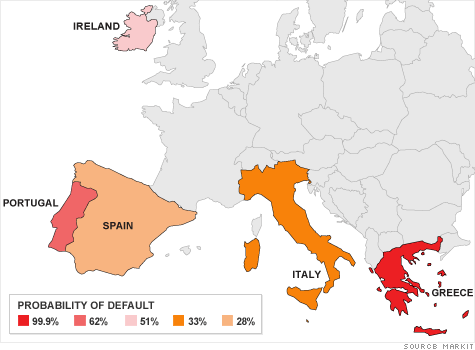
This article aims to address therefore the likely outcome of a Greek default on financial markets. Without the resources at my disposal to look at micro effects, I shall offer my opinion only on macro repercussions.
Looking first at the bond market, the most obvious consequence would be elevated pressure on the nations highlighted above. It's logical to assume bond yields on sovereign debt would rise as a Greek default would likely set a precedent that other indebted nations could follow. This is the nature of Eurozone contagion. The key 'security' (to use the term loosely) in this scenario would be the yield activity on Italian and Spanish 10-year debt. History tell us the tipping point has been 7%, after which borrowing on money market ceases to be economically viable. It would also prove exceptionally difficult to bring the yield back down below this level and hence the downward spiral Greece found itself in all too recently could begin. In terms of AAA rated sovereign debt, I'd imagine these yields to lower as a 'risk off' mode comes into play and investors flock to safe haven assets.
The next major blow would likely be struck upon the banking industry, mainly in Europe but also throughout the world. The link below graphically illustrates relative exposure each nation's banks have to other European nations:
http://www.ft.com/cms/s/0/9686c004-fca4-11df-bfdd-00144feab49a.html#axzz1YavOr400
At a glance it would appear French banks (whose stock prices are currently being dealt hell) would fare the worst from a Greek default. French exposure to Greek debt currently stands at $52.9bn, followed by Germany; $35.7bn and then the United Kingdom, $13.7bn. French and German banks are also the greatest owners of Italian debt, holding $404.9bn and $164.9bn respectively. We can therefore assume both France and Germany would be the hardest hit by a Greek default (which in my view, surely steps up the argument for their parent governments to adopt some sort of Eurobond asap.) Perhaps a more significant outcome, rather than just monetary loss from this situation is the second credit crunch that could follow. A quote from Gary Jenkins, head of fixed income research at Evolution Securities states "you would get the loss on the Greek debt of course, but I think much more important is the funding situation. Who is going to be lending the banks money if you have got Euro Zone sovereigns defaulting and you are unsure about what is going to happen next?" (Source: Reuters)
In accordance with the Capital Allocation Pricing Model, equity markets would also take a drastic hit as bank shares tank, dragging everything else lower. The ability of banks to lend would also be pulled into question and funding for future operations could come to a standstill. By all accounts, this would be more than likely to result in a double dip recession.
Looking on the bright side, some of the biggest gains in stock market history were recorded last year and when the dust finally does settle, there will be many companies out there with no where to go but up. More importantly though it could give countries, banks, the Euro and people the chance at a fresh, debt free start. At present, I for one fail to see the end to the current crisis. Perhaps in time this will come to be known as the perfect solution to an imperfect problem.

No comments:
Post a Comment